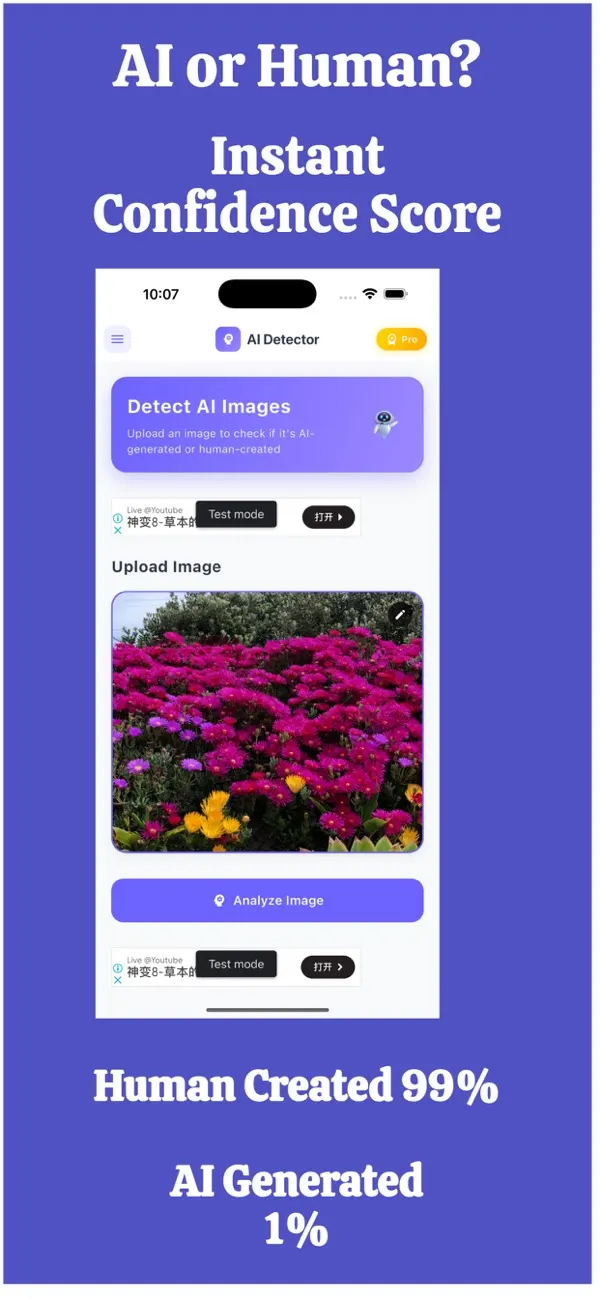
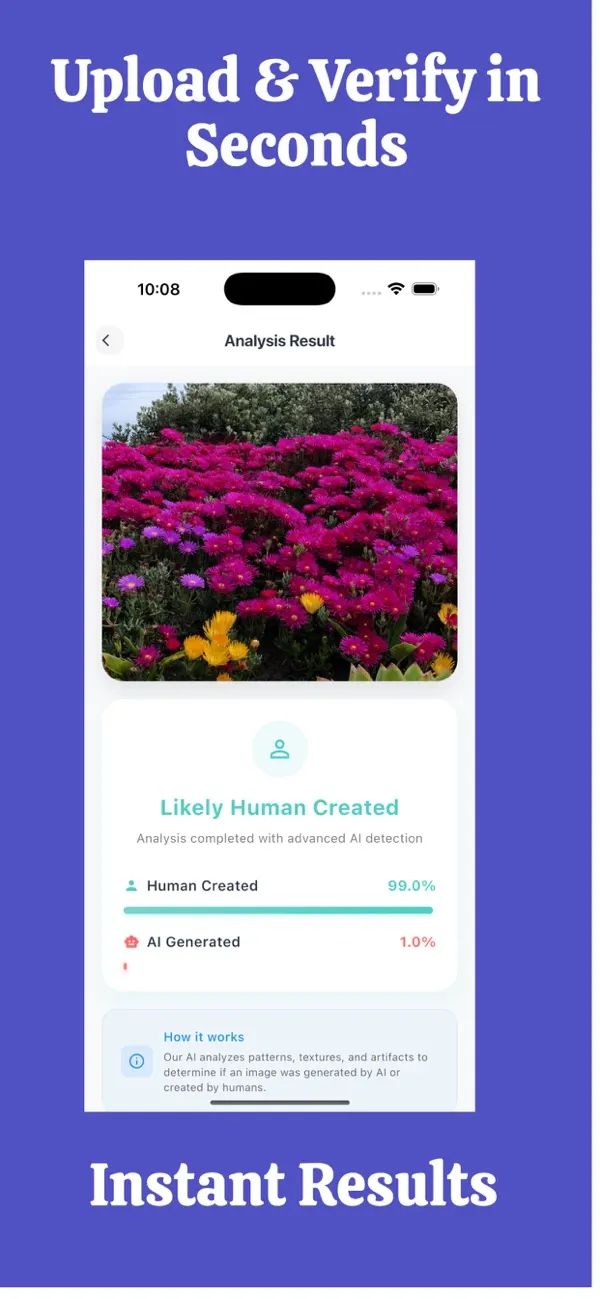
Screens are examples. Results are estimates and can be wrong.
Short answer: AI image detectors are useful, but none is always right. They give an estimate, and they can wrongly flag a real photo or miss an AI-made one. We do not publish a headline accuracy number because a single figure would hide how much results change with the image. Use a detector as one signal among several.
Why can no detector be perfect?
Image generators keep improving, and detectors are always trying to keep up. A detector learns patterns from the images it has seen. When a new generator produces images with different patterns, or when a picture has been resized, compressed or filtered, the signals get weaker. Real photos can also look unusual because of heavy editing or low quality. So two kinds of mistakes exist: a real photo scored as AI (a false alarm) and an AI image scored as real (a miss).
What does a confidence score mean?
A confidence score expresses how strongly the detector leans one way. Think of it like a weather forecast. A high chance of rain does not guarantee rain, and a low chance does not rule it out. In the same way:
- A high "AI-made" score means the detector found many signs of AI generation. Be cautious and look for the original.
- A middling score means the detector is unsure. Treat the photo as unverified.
- A low "AI-made" score means fewer signs were found. It does not prove the photo is real.
FakeSpot: AI Image Detector shows this score so you can see the strength of the signal rather than a bare yes or no.
When are results less reliable?
- Screenshots and re-uploads. Messaging apps and social platforms compress images, which can remove useful detail.
- Small or heavily cropped images. Less information means a weaker estimate.
- Edited or mixed images. A real photo with an AI-generated part may not fit neatly into either category.
- Very new generators. Images from tools a detector has not seen before may be harder to spot.
- Artwork and illustrations. Stylised images are harder to judge than photographs.
How should I combine a detector with other checks?
- Check the source. Who shared it, and can they show the original?
- Run a reverse image search. An older copy elsewhere changes the story.
- Inspect details. Hands, text, reflections and shadows.
- Ask for more. A second photo, a different angle, or a live video call.
- Weigh the stakes. The more is at risk, the less you should rely on any one tool.
The 60-second routine puts these steps in order.
Should I trust a tool that claims near-perfect accuracy?
Be careful. Accuracy depends on which images are tested, and a figure measured on one set of images may not hold on the photos you see in daily life. A trustworthy tool states its limits plainly. That is the standard we try to meet: our results are an estimate and can be wrong.
What is the safest way to use FakeSpot?
Use it to decide how much more checking a photo needs. If the score is high, slow down. If it is low but the source is suspicious, slow down anyway. Keep the exportable report when you need to show how you checked. See the confidence score and report for details, and our app comparison guide for how to judge any detector.
What does a responsible result look like?
A responsible detector tells you three things: what it estimates, how strong the signal is, and that it can be wrong. It should not push you toward a quick accusation. If a result affects another person, such as a seller, a date or a colleague, give them the chance to explain, and ask for a fresh photo or a live video call before drawing a conclusion.
When you are unsure, the honest answer is "unverified". It is a perfectly acceptable place to stop, and it is better than a confident guess that turns out to be wrong.
Frequently asked questions
How accurate is FakeSpot?
FakeSpot gives an estimate and can be wrong. We do not claim a fixed accuracy figure. Use the confidence score as one signal and combine it with source checks.
Why do detectors sometimes flag real photos?
Compression, heavy editing, filters or unusual lighting can create patterns that resemble AI images. This is called a false alarm.
Why do detectors sometimes miss AI images?
New generators and post-processing can hide the patterns detectors look for. This is called a miss.
Is a high score proof of AI?
No. It is a strong reason to be careful and look for the original, but it is not proof.
Will detectors get better over time?
They may improve, but generators improve too. That is why combining checks will stay a sound habit.
Related pages
About the author
Praful Deshmukh is the founder of AppVeda Software, which builds and publishes FakeSpot and other iPhone apps. His apps on the App Store
 FakeSpotSpot AI-generated & fake photos
 ImagineTurn text into stunning AI art
 AI Skin ScannerScan your skin from a selfie
 India AQILive air quality for Indian cities
 AI Video DetectorIs that clip real or AI?