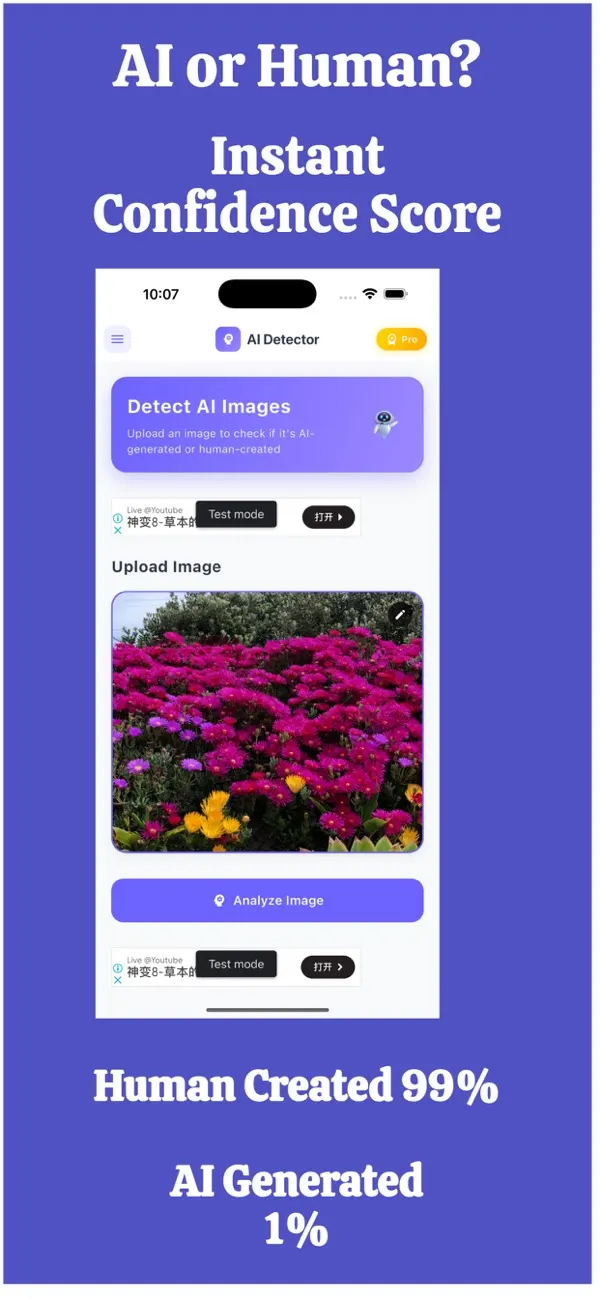
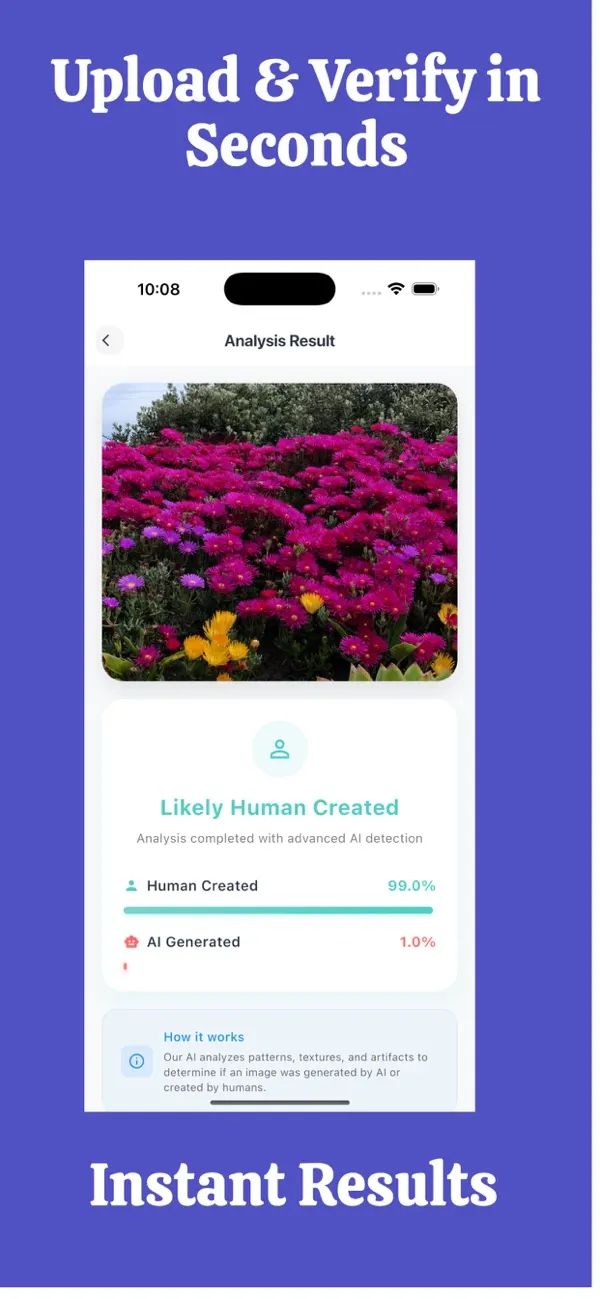
Screens are examples. Results are estimates and can be wrong.
Short answer: a fake photo detector can estimate whether an image was generated by AI. It cannot reliably tell you whether a real photo was edited, or whether a genuine photo is being used in a misleading way. Match the check to the kind of fake.
What is the difference between an AI-made, edited and misleading photo?
| Type | What it means | Can a detector help? |
|---|---|---|
| AI-made | The whole image was generated by a model. No camera was involved. | Yes, this is what an AI image detector estimates. |
| Edited | A real photo was changed: objects removed, faces swapped, colours or details altered. | Partly. Heavy edits may be noticed, but light edits often are not. |
| Misleading | A real, unchanged photo is shown with a false caption, date or place. | No. You need source and context checks. |
What can a fake photo detector tell me?
An AI image detector examines the picture and returns an estimate of how likely it is to be AI-generated. FakeSpot: AI Image Detector does this on iPhone and shows a confidence score. A high score is a warning sign. A low score means fewer signs were found, not that the photo is proven real.
What can it not tell me?
- Whether a real photo was taken at the place and time claimed.
- Whether a caption or story attached to the photo is true.
- Whether someone used a real photo of another person without permission.
- Whether a photo is authentic beyond doubt. Detectors give estimates, and they can be wrong.
How do I check each kind of fake?
For AI-made images
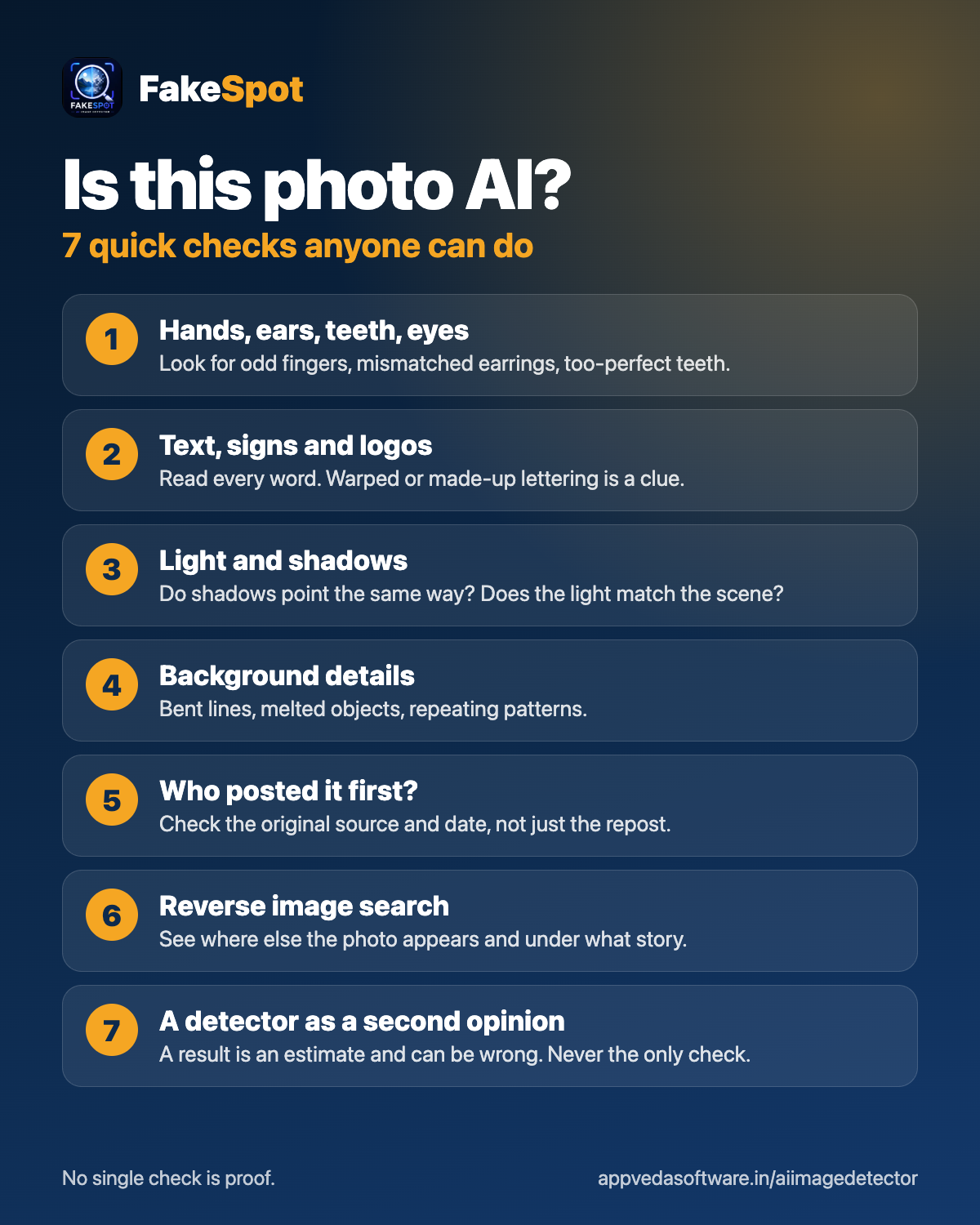
Run an AI check, zoom in on hands, text and reflections, and look for the original source. See the 60-second routine.
For edited photos
Look for mismatched shadows, repeated patterns, warped lines near edited areas and inconsistent noise or sharpness. Ask for the original file, because edits are easier to see in the full-resolution version.
For misleading photos
Run a reverse image search to find the earliest appearance. Compare the claimed date and place with weather, signs, language and landmarks. Check whether trusted outlets report the same event.
What is a sensible way to combine checks?
- Start with the source: who posted it first, and can you reach them?
- Run a detector for the AI question and note the confidence score.
- Search for earlier copies of the image.
- Ask for a second photo, a video call or the original file when the stakes are high.
- Decide based on the whole picture, not any single result.
Our accuracy page explains why a detector's score should never be the only input. For more visual clues, read how to tell if an image is AI-generated.
Does a deepfake count as a fake photo?
A deepfake usually means a face or voice swapped or generated by AI, often in video. Still images that show a person who never did or said something are in the same family. A photo-focused detector may help with still images, but video needs different tools. Results are an estimate and can be wrong, so treat them as one signal, not proof.
What are practical examples of each kind of fake?
- AI-made: a lifelike portrait of a "nurse" on a profile that has no real person behind it.
- Edited: a real product photo where scratches or damage were removed before listing.
- Misleading: a genuine flood photo from years ago posted as breaking news today.
The first case is where an AI image detector helps most. For the second and third, ask for the original file, search for earlier copies, and compare the claim with facts you can check elsewhere.
Frequently asked questions
Can a fake photo detector find Photoshop edits?
Not reliably. Detectors that focus on AI generation may miss light edits. Check for visual inconsistencies and ask for the original file.
What is the difference between a fake photo and an AI photo?
An AI photo is generated by a model. A fake photo is any image that misleads, which includes AI images, edited photos and real photos with false captions.
Can a detector prove a photo is real?
No. It estimates the chance an image is AI-made. A low score is not proof of authenticity.
What should I do with a photo I suspect is fake?
Do not share or act on it. Search for the original, check the source, and run an AI check. Keep the report if you need to explain your decision.
Does FakeSpot check videos?
FakeSpot checks photos. For video, use other verification methods and trusted sources.
Related pages
About the author
Praful Deshmukh is the founder of AppVeda Software, which builds and publishes FakeSpot and other iPhone apps. His apps on the App Store
 FakeSpotSpot AI-generated & fake photos
 ImagineTurn text into stunning AI art
 AI Skin ScannerScan your skin from a selfie
 India AQILive air quality for Indian cities
 AI Video DetectorIs that clip real or AI?